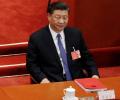
President Xi is also skipping the ASEAN (Association of Southeast Asian Nations) and East Asia summits in Jakarta this week.

The comments by external affairs ministry spokesperson Arindam Bagchi in Delhi came days after China decided to "freeze" visas of two Indian journalists.
The announcement on expansion of CPEC was made following a meeting among Chinese Foreign Minister Wang Yi, his Pakistani counterpart Ishaq Dar and Afghanistan's Acting Foreign Minister Amir Khan Muttaqi in Beijing, according to a Pakistani readout.

China on Monday dismissed the existence of a 'median line' in the volatile Taiwan Strait after Taiwan's defence ministry said it detected a record 103 Chinese warplanes flying around the self-ruled island in a 24-hour period.

China has reiterated its plan to build the world's largest dam over the Brahmaputra River in Tibet, near the Indian border. The Chinese Foreign Ministry has assured that the project, estimated to cost around USD 137 billion, will not have any negative impact on downstream countries, India and Bangladesh. The ministry has stated that the project has undergone rigorous scientific verification and will be conducive to disaster prevention and mitigation, as well as climate change response. India has expressed concerns about the dam, raising the issue during talks with the visiting US National Security Advisor, Jake Sullivan. China has maintained that the project will not negatively affect the lower reaches and has committed to maintaining communication with downstream countries.
Replying to a question on the Kashmir issue raised by a Pakistani journalist, Chinese foreign ministry spokesperson Mao Ning during a media briefing in Beijing said that China's position on the issue of Kashmir has been "consistent and clear".

China Thursday offered to play a 'constructive role' to ease tension between Pakistan and Iran following their missile strikes against each other over the last two days and asked the two countries to 'exercise restraint and calmness and avoid escalation'.
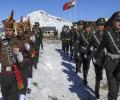
China and India were able to "reduce differences" and build "some consensus" on disengaging troops from friction points to end the standoff in eastern Ladakh and agreed to maintain dialogue to reach a resolution acceptable to both sides at an "early date", the Chinese defence ministry said on Thursday.
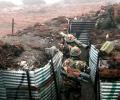
The Chinese military on Thursday said the situation along the India-China border 'at present' is 'generally stable' and both sides have maintained 'effective' communication to resolve the military standoff in eastern Ladakh.

China on Monday said cooperation between countries should not undermine regional peace and stability and target any third party, as it reacted to a host of defence and commercial pacts recently signed between India and the US including joint production of jet engines in India to power military aircraft and a deal on armed drones.

India on Saturday pulled off a big diplomatic win after the G20 summit held under its presidency adopted a consensus declaration overcoming major differences on the Russia-Ukraine war, as Prime Minister Narendra Modi called for ending the "global trust deficit".
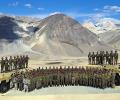
Her comments come a day after External Affairs Minister S Jaishankar said in Geneva that roughly 75 percent of the "disengagement problems" with China are sorted out but the bigger issue has been the increasing militarisation of the frontier.

Chinese President Xi Jinping on Thursday congratulated President-elect Donald Trump on his election victory and called for China and the United States to find the right way to manage the differences by strengthening dialogue and communication.
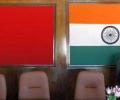
China said that "sound and stable ties" serve the common interests of China and India.

China on Monday termed as "disgraceful" the British government's permission for a Taiwan representative in the UK to sign the condolence book of Queen Elizabeth II, who passed away on September 8.

Announcing the hotline, the Chinese defence ministry said as agreed upon by the defence departments of China and Japan, the two sides have recently completed the construction of a direct telephone line for the sea and air liaison mechanism and will maintain communication on the arrangement for the launch.

Chinese Foreign Minister Qin Gang will travel to India to attend the meeting of G20 foreign ministers on March 2, during which he is expected to hold his first bilateral meeting with External Affairs Minister S Jaishankar.
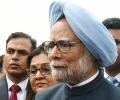
Condolences have poured in from across the globe, including from the United States, Canada and Sri Lanka following the demise of former Prime Minister Manmohan Singh.

Chinese foreign ministry spokesperson Mao Ning said China believes that state-to-state interactions should be in line with the trend of the time which is peace and development rather than exclusivity.
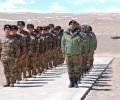
Chinese foreign ministry spokesperson Mao Ning told the media in Beijing on Monday that the two sides held an in-depth exchange of views on expediting the resolution of relevant issues.

China welcomes all initiatives that truly help developing countries build infrastructure and sincere efforts to promote connectivity and common development, the Chinese Foreign Ministry said.
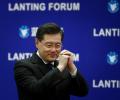
Qin, who is visiting New Delhi to attend the G20 Foreign Ministers meeting on Thursday, is expected to meet Jaishankar on its sidelines though the foreign ministry here is tight-lipped about it.
China on Saturday maintained silence on India's abstention at the voting at the UNHRC on the human rights situation in Xinjiang

Prime Minister Narendra Modi arrived in Bali on Monday for the G20 Summit and bilateral meetings on its sidelines with key leaders attending this annual conference of the world's major economies.
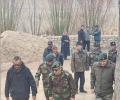
India and China agreed during their military talks on Sunday to stay in close touch and work out a mutually acceptable solution to the "remaining issues" in eastern Ladakh at the earliest, but there was no indication of clear forward movement in ending their three-year-long border standoff.

At the invitation of Prime Minister Narendra Modi, President Xi Jinping and PM Shehbaz Sharif will attend via video conference, the 23rd meeting of the Council of Heads meeting of the SCO on July 4.
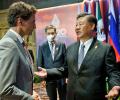
China on Thursday played down what appeared to be a tense conversation between President Xi Jinping and Canadian Prime Minister Justin Trudeau on the sidelines of the G20 summit a day earlier, saying the conversation is "candid, normal" and should not be interpreted as criticism or threat.

China on Tuesday announced that its Defence Minister General Li Shangfu will visit India this week to attend the meeting of SCO defence ministers from April 27 during which he is expected to hold talks with his Indian counterpart Rajnath Singh on ending the prolonged eastern Ladakh standoff which has severely strained bilateral ties.

Speaking on condition of anonymity, the official asserted that it is known that China used these balloons for surveillance.

India and China will complete the disengagement process in the Gogra-Hotsprings area in eastern Ladakh by September 12, the External Affairs Ministry said on Friday.

The US military has intensified its efforts to collect the remnants of the high-altitude surveillance balloon from China that floated over the United States over several days last week from Montana to South Carolina.

A suspected Chinese spy balloon, said to be the size of three buses, was spotted over the United States' airspace, the Pentagon has said, a development that has further strained the already tense bilateral ties as Secretary of State Antony Blinken on Friday abruptly postponed his key visit to Beijing.

'The two sides agree to continue firmly supporting each other in safeguarding their respective core interests,' a joint statement issued at the end of Muizzu's talks with Chinese leaders said.

"The intelligence community and the rest of the government are still looking at this. There's not been a definitive conclusion, so it's difficult for me to say, nor should I feel like I should have to defend press reporting about a possible preliminary indication here," National Security Council Coordinator for Strategic Communications John Kirby told reporters at a daily White House news conference.

Foreign ministry spokesperson Mao Ning went on the offensive saying "we do not believe the entry restriction measures some countries have taken against China are science-based".

The Chinese government on Saturday ordered the release of people detained over a host of coronavirus-related incidents, a day ahead of Beijing's plan to scrap its three-year-old stringently implemented zero-Covid policy.

Officials said 387 passengers were aboard two flights from Toronto and Singapore on the day the country ended its strict COVID-19 restrictions for travellers.

'We should not allow ourselves to be surprised in any manner in future on the border.'
